
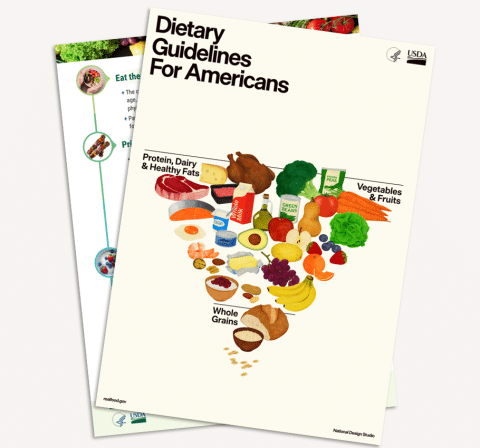
Credit: MyPlate.Gov
Recently, the U.S. Department of Agriculture released an updated food pyramid (shown above). The focus? Protein, dairy and healthy fats are emphasized the most, with a smaller recommended amount of grains (and within that, a focus on whole grains). Three servings of vegetables are recommended per day and two of fruit. Of particular note for parents? Avoid giving kids any added sugar until age 10; previously that guideline was age 2.
To better understand these changes and what they mean for feeding our families, we turned to Stefani Sassos RD, Director of the Good Housekeeping Institute Nutrition & Fitness Lab. Below, read an excerpt from her recent conversation with MomCast host Demetra Ganias. For the full interview, including why fiber is the new protein, listen to MomCast on Apple, Spotify, and now on YouTube.
Let’s talk about the government’s revamp of the food pyramid. It sort of looks flipped upside down?
So we actually did away with the food pyramid years ago. And we had introduced something called MyPlate, but it didn’t catch on. And so now they’ve brought it back, and yes, sort of flipped it.
What do you think of this flip?
To start with the positives, you’ve got protein front and center. We’ve got vegetables up there, and they’re talking about frozen and canned vegetables. Frozen food sometimes can be even more nutritionally dense than fresh because frozen vegetables are going to be flash frozen at their peak ripeness.

Wow, that’s interesting. What do you think about the emphasis on higher fat foods, including saturated fats—previously something that was recommended to limit?
That’s the one thing with this food pyramid that I think a lot of nutrition professionals have questions about, because they’re prioritizing protein [some that are high in fat] and full fat dairy. These can be extremely nutritious foods. A really good high quality piece of red meant can be a multivitamin. But you’re also getting lot of saturated fat. And they even recommended beef tallow, which was one thing that they didn’t tell me in nutrition school to start incorporating into our diet; it almost seems trendy at this point. I think it’s just important to look at the source, right? Really try and focus on the whole foods. Make sure that when you are eating things that are higher in saturated fat, that they’re coming with a full nutritional package.
What is an example of a full nutritional package?
So for instance, I’m a big fan of full fat dairy. And that changed for me, believe it or not, when I went to Greece for the first time.
And what about full fat cheese?
For sure. It’s a full nutritional package, you know, and especially as a child is growing, they need those nutrients. For adults, fat carries a lot of calories. With any of these full fat foods, you don’t want to overdo it but if you’re having whole natural real foods there’s going to be a natural limit there. Your body’s not going to probably overeat a ton of Greek yogurt. What’s it going to overeat? It’s going to be the ultra-processed foods. But we also never want to shame ourselves for going through a drive-through once in a while or giving our kids some amount of snack, sugar, whatever it is.
Speaking of, what are your thoughts on the new sugar guidelines for kids?
We know that kids specifically are eating way too much added sugar in this country, because it’s in so many ultra-processed foods. So naturally, if you’re eliminating some of those foods, you’re going to be having less added sugar. But for me, I don’t think most parents are going to take out this food pyramid and look at it every time they’re putting something on their child’s plate. They’re general guidelines we have to be mindful of.
What do you look for when choosing a snack for your kids, in terms of sugar?
I look for under 10 grams when it comes to added sugar. The reason is that a teaspoon of sugar is four grams. So if you see, let’s say, eight grams on that label, that means there’s two teaspoons of sugar in that. Now, if we’re talking about a really tiny bar, just think about the volume of that and how much sugar is in there. Or are you talking about maybe a large bowl of yogurt? So that is key.
But I don’t think that we should restrict our kids, because guess what? Your child’s relationship with food is thirty times more important than what’s actually in the nutrition of their plate. We should be eating healthy whole nourishing foods, but if you never let your child have a cookie and then they go to some party, they’ll overconsume these foods.